
Why Your Back Pain Keeps Coming Back (And What Your Chiropractor Knows About It)
After 36 years of making mattresses, I’ve had a lot of conversations with people dealing with chronic back pain. The pattern is always similar: “I see my chiropractor regularly. The adjustment helps. But by the next week, I’m back where I started. What am I doing wrong?”
Here’s what most people don’t realize: you’re not doing anything wrong. But you might be spending 8 hours every night undoing what your chiropractor just fixed.
Let me explain What’s HappeniNG
The 56-Hour Problem. Think about what happens between chiropractic visits. You leave the adjustment room with your spine in better alignment than when you walked in. That’s the whole point. Your chiropractor has just spent focused time getting your vertebrae, soft tissue, and muscle tension back toward where they should be. Then you go home and sleep.
If you see your chiropractor weekly, you’re spending roughly 56 hours between appointments lying on whatever surface you call a mattress. That’s 56 hours where your spine is either being held in reasonable alignment, or being pulled progressively out of it. A sagging mattress that lets your hips drop and your lumbar spine flatten out? That’s 56 hours of gentle, continuous distortion working against everything your chiropractor just did.
A too-firm surface that concentrates pressure on your shoulder and hip, forcing you into awkward positions all night? Same problem. Your mattress isn’t neutral. It’s either complementing the treatment or undoing it. And most conventional mattresses - the polyurethane foam and memory foam beds that dominate the market - are working against you.
What Chiropractors See (That You Don’t)
I’ve worked with enough chiropractors over the years to understand how they think about sleep surfaces. And it’s completely different from how mattress stores talk about them.
Mattress stores talk about comfort, luxury, “cloud-like softness,” cooling technology, sleep trials. Chiropractors talk about sagittal alignment, pressure distribution, treatment continuity, and biomechanical load.
To a chiropractor, your mattress isn’t bedding. It’s an extended postural intervention - arguably the longest single biomechanical exposure their patients experience between adjustments. They see patients who sleep on worn-out mattresses that sag in the middle. The hips drop, the lumbar curve flattens, and the patient wakes up stiff. Every single morning, for years.
They see patients on memory foam that contours nicely but doesn’t push back - so pressure points aren’t actually relieved, just displaced into adjacent tissue. The body can’t make its natural micro-adjustments through the night, and inflammation builds up.
They see patients on too-firm surfaces that concentrate pressure and force compensatory positioning - turning what should be restorative sleep into eight hours of low-grade postural stress.
And then they see these same patients week after week, wondering why the pain keeps coming back.
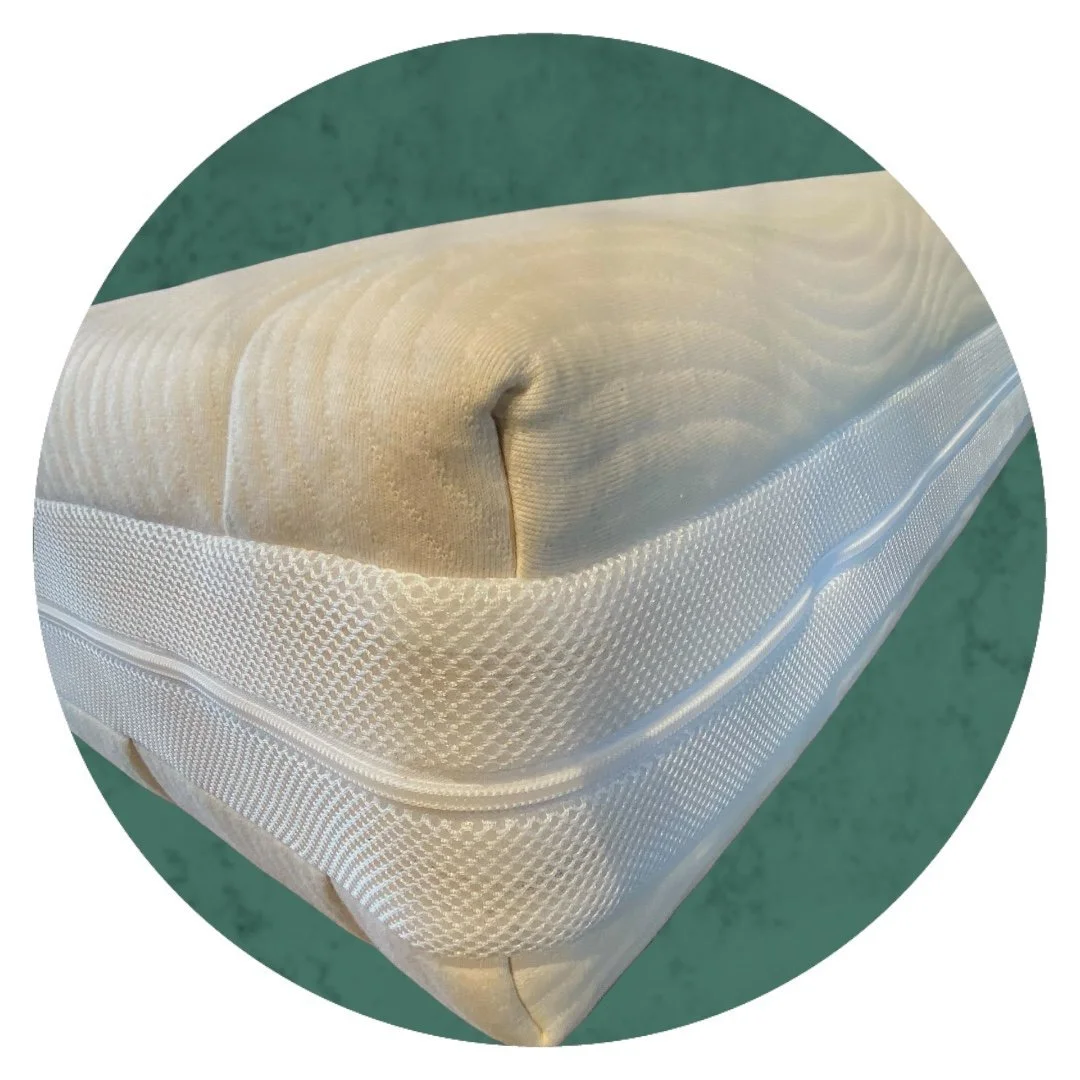
The Clinical Problem with Conventional Mattresses
Most mattresses sold in Australia today are polyurethane foam, memory foam, or innerspring hybrids using PU comfort layers. Three problems show up consistently:
Progressive sag - Polyurethane foam loses support density measurably within 2-3 years. The hips start dropping, the lumbar spine loses its natural curve, and you wake up stiff. Your chiropractor sees you next week wondering why you’re tight again.
Pressure concentration - Memory foam contours to your body, but it doesn’t push back. Your shoulder and hip pressure aren’t actually relieved - they’re just displaced into the surrounding tissue. This encourages micro-arousals and keeps you locked in fixed positions through the night instead of allowing natural movement.
Off-gassing and heat retention - PU foam continues releasing volatile organic compounds for years. It also traps body heat, which drives turning and sympathetic nervous system arousal - neither helpful for the parasympathetic recovery and inflammation reduction your body is trying to do while you sleep.
These aren’t minor inconveniences. They’re biomechanical problems that directly interfere with recovery.
The 8-Hour Gap: What Your Spine Actually Needs
Here’s what most people don’t understand about sleep from a biomechanical perspective:
Your spine needs to stay reasonably neutral for those 8 hours. Not perfectly straight - your spine has natural curves that need to be maintained. But not distorted into positions it wouldn’t naturally hold.
In side sleeping position : Your shoulder and hip are wider than your waist. The surface needs to let those pressure points sink in slightly while still supporting your lumbar curve. If it’s too soft, your whole body sags and your spine curves laterally. If it’s too firm, your shoulder and hip stay elevated and your waist gets no support.
In back sleeping position : Your lumbar curve needs support. Your heavier pelvis needs to be held up from below, not allowed to sink down and flatten your lower back. But your shoulders need enough give that they’re not being pushed forward.
This isn’t about comfort. It’s about maintaining spinal alignment while you’re unconscious and can’t actively correct your position. That’s why chiropractors care so much about what you’re sleeping on. They can adjust you perfectly, but if your mattress is fighting them for 56 hours before you come back, they’re just managing symptoms instead of making progress.
Why Natural Latex Behaves Differently
I didn’t start making latex mattresses because they were trendy or profitable. I started making them because after years of testing different materials, latex was the only thing that actually solved the biomechanical problems chiropractors kept telling me about.
Natural latex is the sap from rubber trees, processed into an open-cell foam. Three properties make it functionally different from polyurethane and memory foam :
Point elasticity - Latex compresses locally under pressure and returns immediately. When your shoulder sinks into the surface, it doesn’t pull your lumbar region down with it. Your lumbar curve gets support while your pressure points get relief. In side sleeping, the surface accommodates your wider pelvis without dragging your spine out of alignment.
Progressive resistance - The deeper you compress latex, the more resistance it provides. Your heavier body regions - pelvis, shoulders - are supported from below rather than allowed to bottom out. Your lighter regions - lumbar curve, neck - are cradled without being pushed out of neutral. This is what “medium-firm” actually means in functional terms.
High-rebound response - Unlike memory foam that traps you in a slow-recovery indentation, latex returns to shape instantly. You’re free to make natural micro-adjustments through the night. This matters because those small movements are how your sleeping body offloads pressure points and keeps blood flowing to compressed tissue. A surface that prevents this movement contributes to the morning stiffness you’re trying to avoid.
What the Research Actually Shows
The clinical evidence on mattresses and back pain has gotten a lot better in the last twenty years.
Here’s what matters:
The Lancet study (2003) - 313 adults with chronic low back pain, randomized and double-blind. At 90 days, patients on medium-firm mattresses had significantly better outcomes than those on firm mattresses for pain in bed, pain on rising, and disability. The accompanying editorial called this a relief for clinicians, given how few interventions actually move the needle on chronic back pain.
Palmer Center for Chiropractic Research - Quantified exactly what happens when a mattress doesn’t accommodate the fact that your pelvis weighs more than your thorax: the lumbar spine gets forced out of neutral alignment and aggravates low back pain. This is the mechanism by which a worn mattress fights your chiropractor’s work.
Multiple clinical studies (2002-2010) - Conducted in chiropractic clinic settings, showing that introducing medium-firm bedding systems produced clinically significant improvements in back pain, shoulder pain, spine stiffness, and sleep quality over 28-day periods.
Pressure mapping research - Direct comparison of latex vs polyurethane across three sleeping positions found latex reduced peak pressure on torso and buttocks and achieved more low pressure surface area. This is the mechanical reason underneath those clinical outcomes.
Finite element analysis (2022) - Combined electronic spinal measurement with computer modeling. Found that compared to a medium mattress, a soft mattress increased disc loading at the cervical level by 49%. A hard mattress reduced lumbar curve and increased contact pressure.
Conclusion : medium firmness isn’t a comfort question, it’s a disc-loading question. Sleep architecture studies - Using polysomnography and EEG to measure actual sleep phases, ergonomically supportive surfaces lowered wake-after-sleep-onset and reduced light sleep, replacing it with more slow-wave sleep. That’s when growth hormone releases, tissue repairs, and inflammation drops. The right surface is doing measurable physiological work.
The consensus now sits at medium to medium-firm as the range associated with best outcomes for back pain, sleep quality, and spinal alignment. The old idea that “firmer is always better” hasn’t survived contact with the evidence.
What I’ve Learned From 36 Years of This
I’ve built mattresses for a lot of people dealing with chronic pain. Athletes trying to recover. Office workers with persistent lower back issues. Side sleepers with shoulder problems. People who’ve tried everything and are frustrated that nothing helps.
What I’ve learned is this: if someone’s seeing a good chiropractor regularly and still not making progress, the mattress is worth looking at seriously. Not because it’s magic. Because it’s 8 hours of biomechanical input that’s either working with their body or against it.
The people who switch to a properly supportive natural latex mattress often tell me the same thing: “I didn’t realize how much my old mattress was contributing to the problem until I wasn’t sleeping on it anymore.”
Their chiropractor usually notices before they do. Adjustments hold better. Tissue stays looser between visits. Progress starts accumulating instead of resetting every week. That’s not marketing. That’s just what happens when you remove an obstacle.
What to Actually Look For
If you’re dealing with back pain and your chiropractor has suggested looking at your mattress, here’s what matters:
Firmness : medium to medium-firm - roughly 6-7 on a 1-10 scale. The goal is spinal neutrality with pressure relief at shoulder and hip. Heavier people usually need slightly firmer; lighter side sleepers usually need slightly softer.
Material : natural latex - outperforms polyurethane and memory foam on pressure distribution, doesn’t sag over time, supports natural movement through the night. Look for GOLS certification - that’s the signal you’re getting actual rubber tree latex, not synthetic blends.
Cover : organic cotton and wool - GOTS certified means no chemical processing. Wool is particularly worth having - it buffers humidity at your skin surface, which moderates temperature without trapping moisture. Also provides natural fire resistance without chemical retardants.
Lifespan : 15-20+ years for natural latex - Most conventional mattresses are biomechanically done by year 7-10 and actively contributing to back pain. Natural latex maintains its support properties for decades.
Frame it as part of treatment - Your chiropractor isn’t suggesting a new mattress to upsell you on something. They’re identifying a variable that’s working against your recovery. The 8 hours on the mattress are doing biomechanical work either with them or against them.
The Real Question
After 36 years of making mattresses, I’ve realized the question isn’t “what’s the most comfortable bed?” The real question is: “What’s happening to my spine during the third of my life I spend unconscious?”
If you’re seeing a chiropractor regularly and still struggling, that question is worth taking seriously. Your mattress is either part of the solution or part of the problem. There’s no neutral position. And if it’s working against you for 56 hours between every adjustment, no amount of treatment is going to get you where you want to be.
That’s not a sales pitch. That’s just biomechanics.
Dan has been handcrafting GOLS certified organic latex mattresses for 36 years - first in Brisbane, now from his workshop on Wallum country on the Sunshine Coast. Every mattress is built to support spinal alignment and work with - not against - your body’s recovery.
Sleep Safe. Live Well.